Customer communication is not new. In fact, contrary to what most might think, it has been around since the dawn of businesses. First, there was the post, then came taxes, then the dawn of emails changed it all, and finally, the boom of the internet revolutionized how we perceive customer communications. There was resistance before every change, people believing that the current way was just enough.
Key Takeaways:
● Customer communications have evolved over time. Now it revolves around real-time, agent-to-agent exosystems, and static documents just can’t keep up.
● Legacy CCM creates communication debt and a stagnation tax through maintenance costs, manual errors, rework, and higher compliance risk.
● Modern CCM focuses on realigning ownership, redesigning approvals, and privatizing context paired with real-time data.
● Organizations that modernize CCM achieve faster time-to-market, better CX, and more resilient compliance than those still using legacy processes.
● Platforms like Perfect Doc Studio help teams operationalize this shift by giving business users no-code control over omnichannel, data-driven communication.
“Why change something that’s not broken?” Stability has been the gold standard for enterprise operations. The past decade saw customer strategies follow the safe, repeatable process with proven templates and predictable outcomes.
The simple idea that if it works now, it’ll work tomorrow. How much weight does it hold in 2026? The same idea has shifted from being a safety net to acting as a blindfold. The communication environment and ecosystem have fundamentally and irreversibly changed. If you’re an organization still chasing after open rates and CTRs, look around again and see how customer communication has evolved in the meantime.
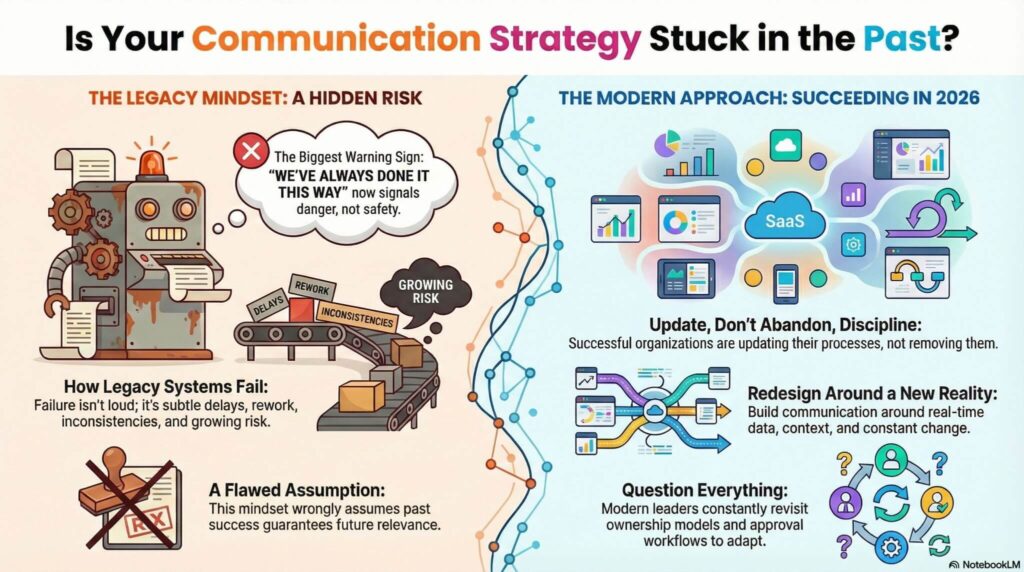
Consistency does matter, but we’ve always done it this way, is not even an excuse for poor CX. Essentially, it’s communication debt that threatens to bankrupt your customer relationships. Here are the risks of relying on obsolete ideas:
The Process Placebo
We often cling to legacy workflows because they feel safe. The simple “Create → Review → Approve → Send” feels familiar and makes you think you’re in control. Technically, both are true. But in 2026, this is just process placebo. You are following the same rules that you’ve always followed to the T. But what happens when the rules have become obsolete?
They were built for a time when:
● Your customers were waiting patiently to open a PDF statement and read it.
● Channels were distinct, and print, email, and mobile were separate silos.
● Data was static, and customer data viewed on Monday is still relevant to a message being sent on Friday.
It’s as simple as a vintage car and a modern car equipped with motion sensors, cameras, and digital connectivity. Both cars can get you to your destination, but the modern car? It offers you so much more than just reaching your destination.
The New Reality
The shift from broadcast to agent-to-agent in 2026 has already happened. Customers aren’t sitting around waiting to read your communications. They now use AI tools to filter their inboxes, summarize their bills, and manage subscriptions. If your communication process outputs a static PDF that an AI agent cannot parse, it practically makes you invisible.
If your data is locked inside a static document that cannot be read by an AI assistant or is not accessible friendly, you’re failing to integrate with a customer’s digital life. The risk is not sending a document with a type or inconveniencing a human; it’s about breaking the digital chain of custody
Perfect Doc Studio provides a centralized platform for designing, generating, and delivering data-driven communications across channels, with business-user-friendly controls and no-code workflows. It supports multilingual, omnichannel experiences and integrates with CRM and BPM systems so teams can modernize CCM without ripping out their existing stack.
The High Cost of Stagnation Tax
Legacy methods incur a stagnation tax. This isn’t typically visible and is both a direct and indirect cost of not switching to a modern CCM strategy.
● The Cost of Maintenance: Industry reports state that maintaining legacy systems costs roughly $720,000 annually. How much money is left for innovation if so much is being paid for a system just to function as it always does?
● The Cost of Data Friction: 50.4% employees mentioned that manual data entry leads to costly errors, delays, or lost opportunities. These data entry errors and reviews result in a direct leak of your organization’s revenue.
● The Cost of Rework: Legacy communications don’t just fail one fine day. It happens gradually, delays in getting a new template approved, inconsistencies between your app and your email, and all of this leads to rework.
● The Cost of Compliance: Breaches with a noncompliance factor cost $174K more on average and $4.61M overall in 2025. Not to mention, with how stringent regulations like GDPR and CCPA have become, can you afford to be non-compliant?
A Brief 2026 Guide for CCM
The organizations that will be successful, generate revenue, and build lasting relationships with customers are those that leverage the most out of modern CCM tools. Here’s how CX leaders and customer-centric organizations approach customer communications:
1. Question Ownership Models
Old Way: Previously, each team had designated responsibilities: marketing handles the brand, IT takes care of templates, and Legal owns the fine print.
New Way: Cross-functional business user-friendly systems.
In a legacy model, changing a single paragraph in a simple customer letter goes through multiple departments. However, the digital era has changed to make it a more collaborative ecosystem through cloud-native platforms where content, data, and design are decoupled.
So now, marketing can use business-friendly tools to adjust content without IT reliance. Legal can verify the fine print, ensuring compliance. And, IT can handle template versioning.
2. Revisit Approval Workflows
Old Way: Everything was linear, and approvals had to be done manually. The process went something like this: Person A → Person B → Person C, with delays and setbacks.
New Way: Logic-based, automated governance with approval built directly into the workflow.
When data hasn’t changed, is there even a need for someone to review and approve it? Modern workflows use “exception-based approval.” If the data falls within pre-set variance limits, the system approves it automatically. Only when anomalies are detected do humans step in. So there is a conscious and productive shift.
3. Redesign Around Context, Not Just Content
Old Way: It’s no longer about whether or not the email looks attractive or whether the content is appealing.
New Way: Relevancy is key. The focus revolves around the right time to send it, the right person to send it to, and the right message to convey.
Instead of focusing on the document itself, we need to focus on the context. Understand the context your customer resides in and align your communication strategies with their needs and preferences. The goal is to make it easier for customers to interact and engage with the document.
In 2026, relevance is everything, and using real-time data is critical. If, for any reason, you aren’t using real-time data, like integration is complex, you are prioritizing your convenience over your CX.
Change is Constant
Naturally, people have always been resistant to change. However, stagnation can be fatal. A new communication architecture takes time and money, involving migration risks, training curves, and initial uncertainty. When customer expectations, regulatory demands, and technological capabilities are increasing, the risk isn’t that the new system will fail or be difficult to adapt to.
If the alternative is your competitors getting ahead of you, loss of revenue, and losing customers’ trust, isn’t the obvious choice to implement a modern CCM system?
Perfect Doc Studio brings CX, marketing, and operations onto a single platform where business users can design, generate, and deliver personalized documents, emails, SMS, WhatsApp, and voice calls without waiting on IT tickets. SIGN UP FOR THE LIFETIME FREEMIUM ACCOUNT NOW!
FAQs
1. What is “communication debt”?Communication debt is the backlog of outdated templates, rigid workflows, and disconnected channels that quietly erode CX and trust over time. Instead of a single big failure, it shows up as rework, slow updates, and messages that no longer fit the customer’s real context.
2. What has changed in customer communication by 2026?Communication has shifted from one-way broadcasts to ecosystems where humans and AI assistants jointly filter, interpret, and act on messages. Customers expect real-time relevance, accessibility, and seamless movement between channels rather than static PDFs that live in inboxes.
3. What is the “stagnation tax” in CCM?The stagnation tax is the combined cost of maintaining legacy systems, fixing manual errors, reworking content, and managing avoidable compliance incidents because you did not modernize. It rarely shows up as a single budget line but steadily drains IT, CX, and legal resources year after year.
4. How much can legacy systems really cost an organization?Analyses of enterprise environments show that maintaining legacy systems can consume hundreds of thousands of dollars annually in direct upkeep alone, before counting productivity loss. When you factor in outages, integration workarounds, and slow change cycles, the total cost of ownership rises sharply.
5. Why should approval workflows be redesigned in 2026?Linear, person-by-person approvals do not match the pace of real-time data and omnichannel campaigns. Logic-based workflows with built-in governance keep compliance intact while dramatically reducing the lag between strategy decisions and live communication.
6. Why is modern CCM critical for compliance in 2026?Regulations like GDPR and CCPA continue to evolve, and non-compliance can significantly increase the cost and impact of data breaches. Modern CCM platforms make it easier to enforce consent, retention, and disclosure rules consistently across every channel.
7. How does a modern CCM platform support CX teams specifically?Modern CCM tools give CX and marketing teams self-service control over templates, variants, and journeys without requiring constant IT intervention. This means faster iteration, cleaner experiments, and communication that can keep up with customer feedback loops.