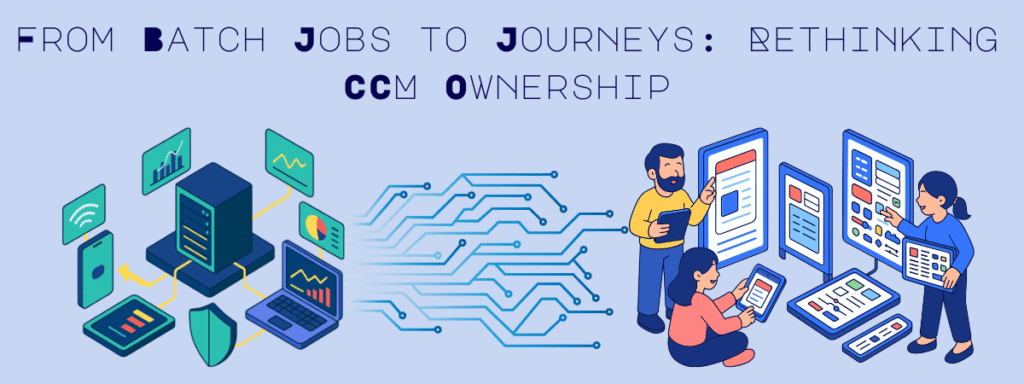
In a legacy bank or insurer, the CCM conversation revolves around batch processing, print streams, spool files, and uptime SLAs. This is exactly what CCM means to those still stuck with decades-old equipment and technology, shying away from the latest technology. This could be for a variety of reasons: migration, investment, resistance from employees, and more; you name it, and it could be one of the reasons.
The early 2000s saw a significant increase in customer communications. It resulted in a logistics nightmare, which required servers and a massive mainframe to churn out data, format it onto a page, and send it out to printing, all without crashing the system. So, back then, this was an IT problem. How did we respond? By delegating this to the IT team.
But as time passed, CCM was no longer just an IT hassle; it evolved into a customer experience issue.
Key Takeaways:
- Legacy CCM was built for mainframes and print streams, resulting in it being an IT issue rather than what it should be in today’s customer-centric era: a customer experience asset.
- Customers care about whether communications being sent to them are clear, human, and timely on any device.
- Keeping CCM inside IT creates ticket queues and weeks’ worth of delays to make even the simplest of changes.
- A modern model lets IT handle infrastructure while CX and content teams manage templates, tone, logic, and testing through no‑code tools.
- Interactive, mobile‑ready communications are turning documents into journeys, making CCM a frontline CX function rather than a back‑office utility.
As we step into 2026, we still see legacy tech functioning in legacy organizations. It may not be efficient, but it works nonetheless. What organizations fail to realize is that your customers, however, don’t care about your batch processing windows. They care that their renewal notice was impersonal, their claim denial was jargon-heavy and garbled on their iPhone or Android device.
This misalignment is what modern enterprise CCM solves. The difference between how legacy systems treat their customers as IT tickets that need to be resolved, vs. customer-centric platforms.
The future of CCM relies on Customer Experience and not Information Technology.
Let’s look at a paradoxical scenario that plays out in Fortune 5000 companies every day:
A CX director reviews a standard policy renewal letter and notices the language feels cold, legalistic, and missing a link to a new self-service portal that could prevent the support team from being overwhelmed by calls, saving them $2 million.
In a modern company, she could just as easily open the template and edit the copy herself. Then, A/B testing can be done, and push it to production with a marketing email or website banner.
This, of course, is for a modern, agile organization, but in an IT-owned CCM model, this is how the same scenario would play out.
- A ticket would be filed with the core system team.
- The ticket sits in a backlog of multiple other tickets, sometimes even for weeks. The CCM developers are busy with tasks and overwhelmed with other tickets.
- A developer finally picks up the ticket and makes the changes (not always, though; maybe they misunderstood the ticket, leading to more back-and-forth).
- Two weeks of regression testing to ensure the changes work fine.
- The total time to change a few sentences takes 6 weeks.
By the time the letter goes out, the marketing campaign’s time frame has already run its course.
They know this time-consuming, tedious process does more harm than good. IT teams would only prioritize stability, security, and throughput. They are not incentivized on empathy, conversion, or clarity. Asking a developer to understand and address the emotional nuances required in customer communications is no different from asking an engineer to decorate the interiors of your home. They can ensure the walls don’t collapse, but can they transform a building into a warm home?
The Emails That People Actually Read:
Most marketing emails are ignored, so which emails do customers actually open? A bill, policy renewal, and fraud alerts. Such emails have an open rate of nearly 95% while marketing emails’ open rates are around 20%.
A bill isn’t just a request for money or payment. It is a validation of value. A policy renewal is not just a receipt but reassurance telling the customer, you’ll be safe. A policy kit isn’t a legal obligation, but the product that a customer has bought.
When these assets are handled by IT, they are treated as output. When these same pieces of communication are handled by CX teams, they are treated as conversations that offer value to customers. The shift in ownership shows how a company adds value and attracts a customer’s attention.
The New Model: It As An Architect And CX As The Designer
Just because IT is detached doesn’t mean they don’t have a place in customer communications. The complexity of modern CCM includes omnichannel delivery, real-time APIs, and intense security compliance (GDPR, HIPAA). IT’s role must shift to the position of an enabler, assisting business users like the marketing team, customer support team, sales team, and others.
The smartest thing to do is for IT to own the infrastructure and CX to own the experience.
IT Teams: They manage and ensure data from core systems is clean. The delivery channels are secure, and APIs that trigger messages are handled properly. Essentially, IT teams built the foundation for business users to thrive.
Business User Focusing on CX: They control the templates, the logic, and the tone using business-user-friendly platforms. No-code tools prevent the previously mentioned backlog that relied on technical teams. Changes can now be made independently in minutes instead of weeks.
This split allows IT to focus on reliability and security, which they truly excel in, and CS to focus on empathy and engagement, which matters to customers.
If you are evaluating platforms, this comparison of Perfect Doc Studio vs traditional CCM suites like Quadient, SmartCOMM, and OpenText breaks down how each one handles migration, scale, and business‑user control.
Final Thoughts: Moving from Output to Outcome
The urgency for this shift is being driven by technology that did not exist a few years ago. Resistance from employees and management is normal, but look at your competition, notice the shift towards headless CCM and interactive documents?
Just a decade ago, in the IT-led era, a document or a PFF meant a digital piece of paper, static and dead. In the CXM-led world, a document is now an interactive HTML5 experience.
- A utility bill that, by clicking a graph, lets the customer see when and why usage spiked on Tuesdays.
- An insurance policy that includes a premium vs coverage chart that details everything in plain English.
- A bank statement that lets you dispute a charge directly from the line item without leaving the document.
A CCM team that is worried about page breaks and printer margins cannot even imagine building such a seamless and customer-centric experience. Only a CCM team devoted to User Experience (UX) and Customer Journey Mapping can offer such an experience to their customers.
A CX first model needs a platform that enables business users to take the front seat. Perfect Doc Studio gives CX, product, and marketing teams a no‑code design studio on top of enterprise‑grade infrastructure, so they can update templates, rules, and layouts without opening an IT ticket.
Check out the lifetime freemium version and try for yourself today!
Check your organization’s bills, statements, and notifications. Do they sound and represent your brand? Or do they sound like your mainframe?
Because in the end, your customers don’t experience your infrastructure. They don’t care about how many batches it can process. They experience your communication, and that makes CCM a CX function.
FAQs
1. Why should CCM be owned by CX instead of IT?In legacy organizations, CCM was designed around mainframes, batch jobs, and print streams, so IT naturally owned it. As communication moved from static output to real‑time, personalized interactions, the impact shifted from infrastructure uptime to customer trust, clarity, and retention, which are core CX outcomes.
2. What is the risk of keeping CCM inside IT in 2026?When IT controls every change, even minor wording updates become tickets that sit in queues, delay campaigns, and block responsive communication. This slows the business, hurts customer experience, and prevents teams from testing better language, layouts, and journeys.
3. How does modern CCM improve customer experience?Modern CCM platforms allow business users to design, personalize, and update communications themselves, without waiting on developers. This makes bills clearer, policy kits easier to understand, and alerts more helpful, directly boosting satisfaction and loyalty.
4. Why are transactional communications more important than marketing emails?Customers ignore most promotional emails but almost always open a bill, policy renewal, or fraud alert because these touch money, risk, or security. That makes transactional communications one of the most valuable levers for shaping perception, reducing churn, and building trust.
5. What does a CX‑led CCM operating model look like?IT owns the infrastructure—data, security, integration, and delivery—while CX and content teams own templates, logic, tone, and timing. No‑code CCM tools bridge the gap so business users can change communications in minutes while IT keeps the platform stable and compliant.
6. How can enterprises transition from legacy CCM without disrupting operations?A practical approach is to keep core systems running while gradually moving templates onto a modern CCM platform with migration tooling. Start with high‑volume, high‑impact documents like bills and renewals, then expand as teams gain confidence and see ROI.
7. What features should a CX‑first CCM platform offer?Key features include no‑code template design, omnichannel output, strong data integration, batch processing, and support for interactive, mobile‑friendly documents. It should also support personalization rules, multilingual content, and easy collaboration between business and IT.