

5 Enterprise Goals for AI in CCM in 2026
The previous year saw how much of an impact AI has had on enterprise operations. From entry-level employees to upper management, use ChatGPT plugins, automated writing tools, and copilots. The more we use these AI tools, the more technological leaders realize the challenges that come with them. Organizations are not ready in terms of readiness or proper and large-scale implementation of AI across the organization. We now see that 2025 has removed the reluctance and hesitation in AI’s usage, but can 2026 witness the integration of AI tech that can maximize productivity and potential?
Key Takeaways:
● Ditch copy-paste: Embed AI natively in CCM templates and approvals.
● Stop random prompts: Build libraries with compliance and metrics.
● Codify policies: Turn style guides into auto-inserted logic.
● Hybrid governance: Central standards, local execution like AWS.
● Train teams: New roles and ROI incentives drive adoption.
2025 saw fragmented wins. Content teams were able to draft emails with generative AI and copy and paste them into the CCM or CRM platforms. Marketing teams used AI to analyze communication history and come up with strategies and campaigns. Yet, compliance teams couldn’t solely rely on AI for thorough checks and verifications. They still had to manually verify communications.
It was evident that organizations were saving time with drafting communications using chat tools and drafting assistants, but the friction points remained the same. They were still stuck with fragmented workflows, manual handoffs, approval cycles, and more. In simple words, AI improves the individual tasks, but the time it takes for the actual communication cycle remains the same.
An industry survey of 120,000+ enterprise respondents revealed that only 9% of companies report having AI agents deployed in production, while 64% report no formalized AI initiative at all.
What is this if not an AI purgatory of being neither here nor there
So now leaders have understood that technology isn’t the problem. The technology has advanced significantly, overcoming many of the glitches that it once had. The shift needs to go from individual team usage to systemic structural change. For an organization to truly commit to using AI, it needs to organize its people, processes, and politics. Even the best LLMs out there would underperform if employees fear them and lack in-depth knowledge, or if approval processes are left unchanged. The goal is to redesign how the entire system works rather than adding a few fancy tools.
Goals Enterprises Adopting AI Should Strive for in 2026
1. Embed AI in the Communication Backbone:
AI must be an integral part of your CCM/CXM platform, living inside your template logic, data binding, and existing workflows. Practically, the interface that contains the templates and approvals should also contain a writer for a translator without the need to switch interfaces or platforms. So instead of copy-pasting text from a different application, embedded AI can generate messages within the right templates, include the correct data fields, and encompass the appropriate security tags automatically.
1. Embed AI in the Communication Backbone:
AI must be an integral part of your CCM/CXM platform, living inside your template logic, data binding, and existing workflows. Practically, the interface that contains the templates and approvals should also contain a writer for a translator without the need to switch interfaces or platforms. So instead of copy-pasting text from a different application, embedded AI can generate messages within the right templates, include the correct data fields, and encompass the appropriate security tags automatically.
2. Standardize Prompts and Workflows:
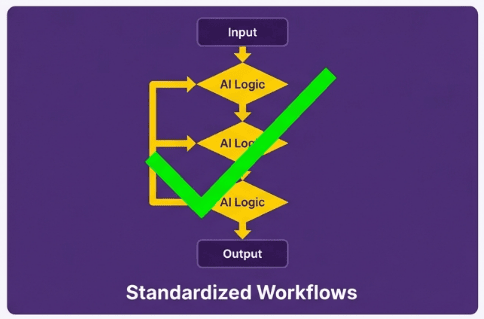
Ad-hoc prompting and prompt culture need to be stopped. Rather, we must implement standardized workflows and repeatable systems, so teams use AI-driven templates embedded with compliance rules and appropriate tone. Likewise, OpenAI’s research focuses on the usage of structured AI workflows (projects, custom bots, APIs). This is indicative of companies favouring an integrated approach over random prompts. Simply put, the future must include not just template libraries but also prompt libraries to ensure consistency. In 2026, we will see teams shift from “make this better” or “tell ChatGPT to do this” to orchestrated flows where every AI action is logged, versioned, and tied to metrics.
2. Standardize Prompts and Workflows:
Ad-hoc prompting and prompt culture need to be stopped. Rather, we must implement standardized workflows and repeatable systems, so teams use AI-driven templates embedded with compliance rules and appropriate tone. Likewise, OpenAI’s research focuses on the usage of structured AI workflows (projects, custom bots, APIs). This is indicative of companies favouring an integrated approach over random prompts. Simply put, the future must include not just template libraries but also prompt libraries to ensure consistency. In 2026, we will see teams shift from “make this better” or “tell ChatGPT to do this” to orchestrated flows where every AI action is logged, versioned, and tied to metrics.
3. Turn Communicational Knowledge into Machine-Readable Logic:
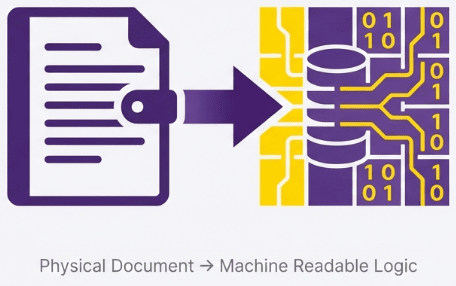
Every organization has accumulated unique style guides, legal disclaimers, and customer communication policies. Either employees are aware of them, or they are in PDF formats. This knowledge or policy needs to be codified and converted into machine-readable logic to expose customer data through APIs. Through the practice of linking a knowledge base or business rules engine to the AI, the model can automatically insert the correct legal paragraph for a healthcare notice. This way, there are fewer compliance slip-ups.
3. Turn Communicational Knowledge into Machine-Readable Logic:
Every organization has accumulated unique style guides, legal disclaimers, and customer communication policies. Either employees are aware of them, or they are in PDF formats. This knowledge or policy needs to be codified and converted into machine-readable logic to expose customer data through APIs. Through the practice of linking a knowledge base or business rules engine to the AI, the model can automatically insert the correct legal paragraph for a healthcare notice. This way, there are fewer compliance slip-ups.
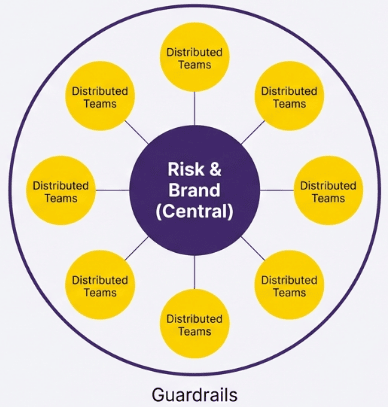
4. Govern Centrally, Execute Locally:
It is impossible for one model to accomadate every industry or domain. And that is why even AWS advocates for a federated model. Basically, they state that shared data standards, core AI models, and monitoring should be limited to IT teams, while decentralizing innovation to domain teams. A working example of this is where IT manages the central LLM platform to publish secure, approved model endpoints, and business teams like finance or marketing use those standards to build a bot that suits their unique needs. In practice, an AI model would be pre-set with policies and API frameworks, while a marketing team runs their own trained chatbots under those guardrails. Similar to AWS’s guidance: a hybrid strategy “combines robust governance with agile delivery”.
4. Govern Centrally, Execute Locally:
It is impossible for one model to accomadate every industry or domain. And that is why even AWS advocates for a federated model. Basically, they state that shared data standards, core AI models, and monitoring should be limited to IT teams, while decentralizing innovation to domain teams. A working example of this is where IT manages the central LLM platform to publish secure, approved model endpoints, and business teams like finance or marketing use those standards to build a bot that suits their unique needs. In practice, an AI model would be pre-set with policies and API frameworks, while a marketing team runs their own trained chatbots under those guardrails. Similar to AWS’s guidance: a hybrid strategy “combines robust governance with agile delivery”.
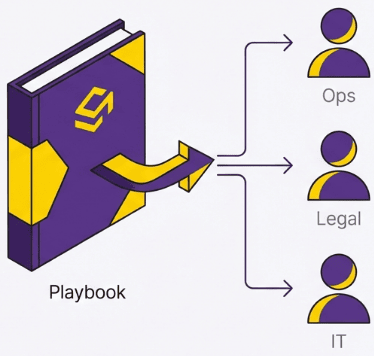
5. Investment in People and an Internal Playbook:
The biggest challenge has always been whether people trust the tool, let alone know how to use it. If enterprises are looking at rolling out the changes, training, and governed boundaries play a pivotal role. New designations like AI coordinators or prompt engineers are now becoming commonplace. Teams should know how and when to use AI. Management should hold teams accountable based on clear ROI goals, while rewarding early adopters. Such incentives would push AI-driven initiatives so people don’t just automate tasks, but transform how an organization functions at its core.
5. Investment in People and an Internal Playbook:
The biggest challenge has always been whether people trust the tool, let alone know how to use it. If enterprises are looking at rolling out the changes, training, and governed boundaries play a pivotal role. New designations like AI coordinators or prompt engineers are now becoming commonplace. Teams should know how and when to use AI. Management should hold teams accountable based on clear ROI goals, while rewarding early adopters. Such incentives would push AI-driven initiatives so people don’t just automate tasks, but transform how an organization functions at its core.
Final Thoughts
The goal isn’t just enhancing the speed at which tasks are completed, but amplifying speed without compromising on compliance or brand consistency. The real ROI is seen in measures like “speed to market” and not “individual tasks”. So AI adoption and improvement should be measured based on whether it can shorten the end-to-end cycle – launching a product, responding to a customer issue, issuing a statement – while maintaining accuracy.
Perfect Doc Studio embeds generative workflows directly in the CCM engine: you design templates once, and AI populates them in 100+ languages; approvals and compliance rules stay attached to the documents no matter how many times they change.
FAQs
AI purgatory describes organizations stuck between basic AI tool usage and full integration, achieving fragmented task improvements without shortening overall communication cycles or workflows. Only 9% of companies have AI agents in production, while 64% lack any formalized initiative.
Embed AI directly into CCM/CXM templates, data binding, and workflows so generation happens in one interface—no copy-pasting from ChatGPT. This ensures compliant, personalized messages with automatic security tags and data fields.
Ad-hoc prompting leads to inconsistency; standardized workflows with prompt libraries, compliance rules, and logging tie AI actions to metrics and version control. OpenAI’s projects and custom bots show this shift toward orchestrated flows.
IT handles core models, data standards, and monitoring centrally, while teams build domain-specific bots under those guardrails—like AWS’s hybrid approach for governance and agility.
Perfect Doc Studio embeds generative AI in its CCM engine, populating templates in 100+ languages with approvals and compliance intact, turning it into a true CX tool for seamless multichannel delivery.
Improving efficiency in the contract creation process
Contracts are the legal basis for all of the business interactions between a company and its custome
Bridging the corporate communications gap with localization
The world of digital communications in business is evolving. Many businesses are beginning to realiz
Top 5 Emerging Salesforce Document Generation Tools Compared: Features, Pricing, and User Reviews
This blog highlights leading Salesforce document generation tools, comparing their features, pricing